Research
Knowledge Management
Academic
How to Build a Research Library That Thinks With You
Why Research Tools Are Stuck in the Past
For many researchers, the process of managing academic work is fundamentally broken.
There is unprecedented access to a universe of information, yet the ability to synthesize it is often throttled by the very tools used for the job. Most digital workflows are, in essence, faster versions of analog habits. Digital folders are filing cabinets that don't take up physical space. Separate note-takers are digital index cards. The containers have been digitized, but the process of manually connecting the dots remains unchanged.
The real work, the intellectual synthesis that leads to a breakthrough is still expected to happen entirely inside the researcher's head. This process involves juggling dozens of concepts and trying to recall crucial quotes from papers read months ago. It is an exhausting, inefficient way to work, and it actively gets in the way of deep thinking.
Building a Library That Thinks With You
This reality raises a critical question: what if a research library wasn't just a passive archive? What if it could become an active partner in the thinking process? A space where the connections between ideas were not just in memory, but were tangible, visible, and even queryable.
This is the principle behind Vilva.ai. It is designed to create a single, intelligent environment for a project, where papers, notes, and data can coexist and interconnect. Instead of a simple list of files, a researcher begins to build a visual map of their intellectual territory. Complex papers can be broken down into their core arguments and connected to other concepts, creating a network of understanding.
A Concrete Example: Deconstructing a Paper
To make this concept concrete, consider a foundational paper like "Attention Is All You Need," which introduced the Transformer architecture still standing as the backbone of AI. In a typical workflow, this PDF sits in a folder. Here, it is repositioned as the center of a small universe of interconnected ideas.
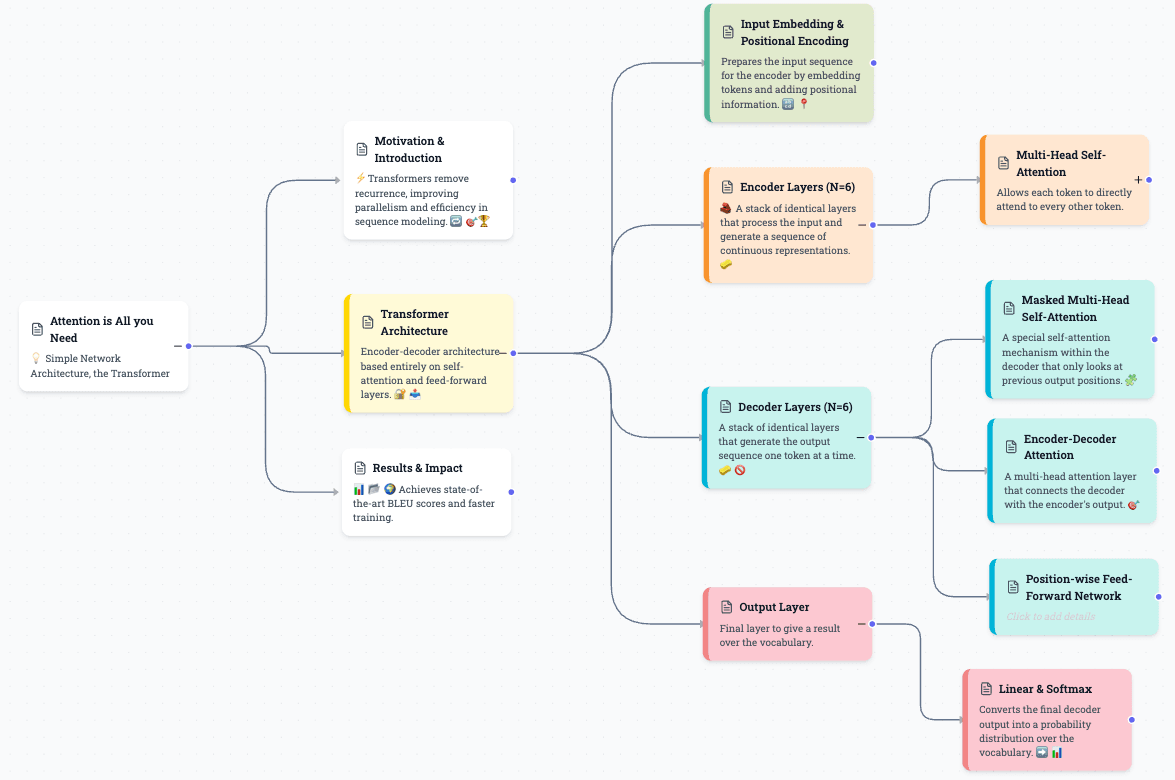
In this model, the paper is no longer just a file, it is a central node that branches out to its core components (Encoder, Decoder layers) & its famous applications. It is the paper, plus its context, all in one view.
The real power of this model is that the map is alive. It can be interrogated. A researcher can literally query their own curated library to ask things like, "What are the primary criticisms of the original Transformer architecture?" and receive a synthesized answer drawn from the information they provided.
The interactive workspace for this example can be explored directly here.
Moving from Clerical Work to Actual Research
Adopting this approach can fundamentally change the nature of academic work. It allows a researcher to spend far less time on the cognitive clerical tasks by hunting for files, trying to recall specific details and more time asking bigger, more interesting questions. It helps transform a static pile of literature into a dynamic knowledge base that can be genuinely interacted with.
This is a significant step toward making research tools work for, not against, the user. It creates a space where the focus can shift from merely managing information to generating the insights that truly matter.
Shruti