
Productivity in the Creative World
AI has collapsed the cost of a single generation to near zero, but professional content still takes weeks. The bottleneck moved from making assets to orchestrating them. Here is why integration beats tools, and why simplicity is the productivity lever.
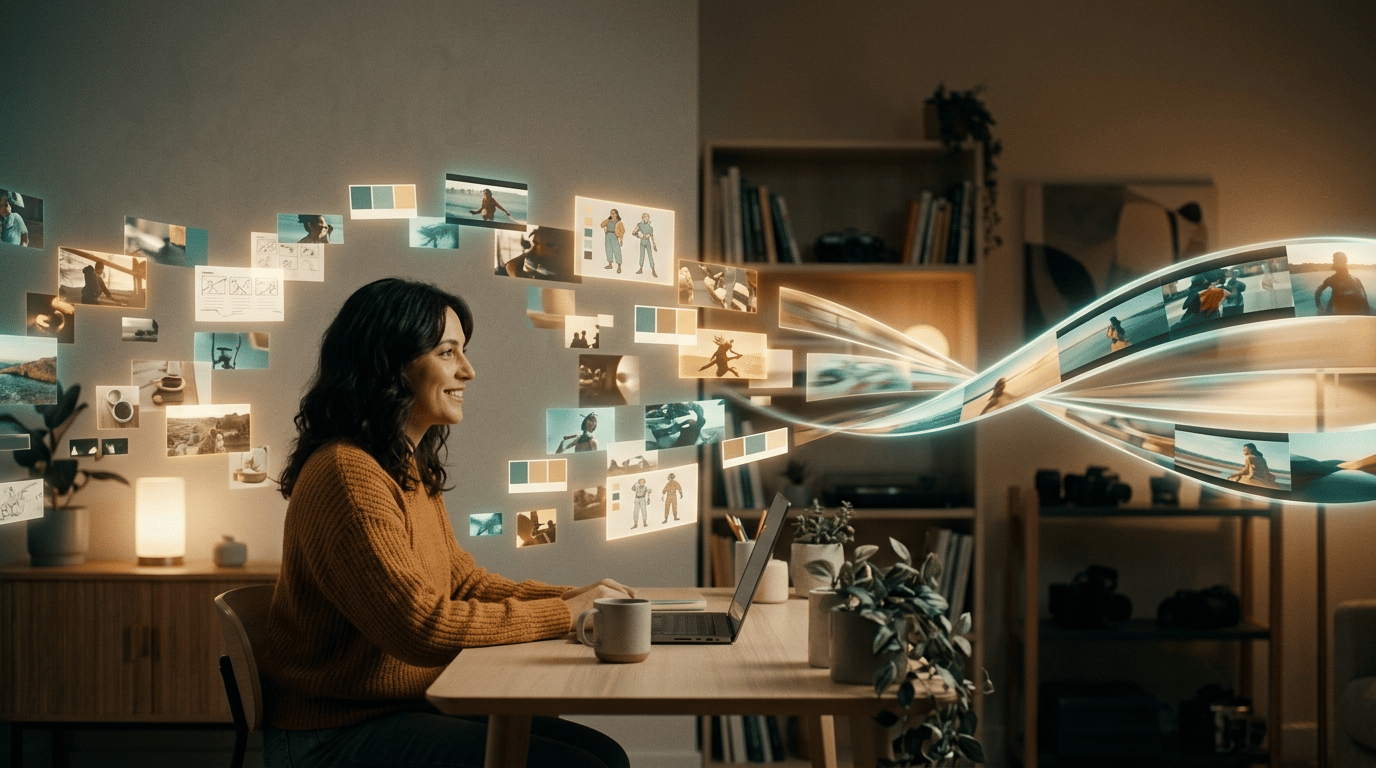
A feature film takes three to five years. A national ad campaign takes six to twelve weeks. A single brand photoshoot, with location, crew, and retouching, takes the better part of a month before the first usable frame ships.
Those timelines were not set by laziness. They were set by physics. You cannot light a set, direct talent, shoot coverage, cut, grade, and finish faster than the slowest human in the chain can work. For a century, the cost of making any single image or second of footage was high enough that the entire industry organized itself around scarcity: storyboards to avoid wasted shooting days, dailies to catch mistakes early, locked edits to stop the bleeding.
That world is ending. Not slowly.
The cost of one frame went to zero
A text-to-image model returns a usable draw in seconds. A text-to-video model returns a few seconds of coherent footage in minutes. What used to need a camera, a crew, and a budget now needs a sentence and some credits.
Measured per asset, this is not a 2x or even 10x speedup. A concept frame that took a concept artist a full day now arrives before you finish a couple of sips of coffee. A rough animatic that took a week now takes an afternoon. This is real, it is in production today, and anyone who tells you it is hype has not tried to ship work with these tools.
So the obvious conclusion is that creative work is now effectively instant.
It is not. And the reason it is not is the whole story.
The bottleneck moved, it did not disappear
Watch someone try to make something professional with these tools and the pattern is always the same. The first image is magic. The tenth is a fight. The full deliverable .. a 60-second spot, a consistent character across a series, a product that looks identical in twelve frames .. is a slog that still eats days or weeks.
The cost of a single generation collapsed. The cost of a coherent body of work did not. Because professional content was never bottlenecked on making one asset. It was bottlenecked on everything around the asset:
- Holding a character, a product, a brand palette steady across every shot.
- Routing each piece to the right model, then moving it between tools without losing fidelity.
- Keeping the forty near-misses so you can branch from the good one instead of starting over.
- Upscaling, editing, compositing, grading, cutting .. the assembly that turns a draft into a deliverable.
- Judging which of the forty draws is actually the keeper.
AI made step one free. Steps two through five are exactly where the weeks still go. We took the slowest part of the old process, the shooting, and made it instant, only to discover the slow part was never the shooting. It was the orchestration. And we still do that by hand, across a dozen disconnected tabs, copying files between tools that do not know each other exist.
Why we still have a long way to go
Top-tier professional content .. the kind that holds up on a cinema screen or carries a global brand .. demands consistency, intent, and finish. A model gives you a brilliant single sample. It does not give you the second shot that remembers the first, the edit that serves the story, or the taste to know which take to keep.
Those are structural problems, not sampling problems. A better model draws a better single frame. It does not remember what it drew last time, assemble forty drafts into a sequence, or carry your art director's intent from the first frame to the last. We will stay a long way from one-prompt films as long as the missing piece is structure and taste, not raw model quality.
You cannot prompt your way across that gap. You can only build your way across it. And right now, most people are building it by hand, badly, in tooling that fights them.
The lever is integration, not more tools
Here is the trap the industry is walking into: answering an abundance of cheap generation with an abundance of disconnected tools. One app for images, another for video, a third for upscaling, a fourth for editing, a spreadsheet to track versions, a folder system held together by hope.
Every handoff between those tools is a tax. Export, re-import, re-describe your character, lose the reference, lose the version history, lose the thread. You can have the fastest generation in the world and still ship slowly, because the friction moved into the seams between your tools.
Productivity in the AI era will not come from a faster model. It will come from collapsing those seams .. from a system where generation, reference, routing, versioning, and assembly live in one place and pass work between each other without a tax. The unit of leverage is not the tool. It is the integrated system that turns a dozen tools into one continuous motion.
The goal is not to automate the creative. It is to build the system that lets a creative hold a whole production in their head and move through it without fighting their software.
Simplicity is the productivity feature
There is an obvious objection: integrated systems are complex, and complex tools are slow to learn. A node graph that can route a shot across five models and node types sounds like something you need a huge manual for.
This is the part most platforms get wrong, and it is the part we built Vilva around. A powerful system that takes three weeks to learn does not raise a team's productivity. It raises one specialist's productivity and leaves everyone else behind. The leverage only shows up when the whole team can use it on day one.
So simplicity is not a nice-to-have on top of the system. It is the mechanism that makes the system pay off. The two core bets behind Vilva are exactly these:
- Near-zero learning curve. If a creative director, a marketer, and a brand-new hire can sit down and ship something coherent in their first session, the productivity gain is real and immediate. If they need training, it is not.
- Agents to do the busy-work. Why does a creative have to configure the same model across 15 nodes and pick the right voice for the right image to generate a video? Not anymore as the agent has all the context of the project, so the creative just chats.
- Built to scale across teams. A workflow one person builds should be something the next person can pick up, run, and adapt without a handoff meeting. The pipeline becomes shared infrastructure, not tribal knowledge locked in one expert's head.
Intuitiveness is what turns individual speed into organizational speed. The win is not one artist going faster. It is a whole team moving as one, because the system is simple enough that nobody is the bottleneck.
The simplest interface is a conversation
There is one more step past a system you can learn on day one: a system you barely have to operate at all.
Once the tool is integrated and simple, an agent can sit on top of it.. one that knows you, your brand, your palette, the way you like a shot framed, the models you tend to reach for. At that point you stop configuring and start conversing. "Three variations of the hero shot in our brand colors, keep the character consistent, then cut a 15-second version for stories." The agent picks the models, pulls in the references, holds the brand steady, and assembles the drafts. You review, react, and redirect.. the part only a human should own.
That is the line between a faster tool and a real collaborator. The hours that used to disappear into configuring nodes, routing, re-describing your character, and wrangling versions come back to you. Your attention stays on the decisions that carry taste and intent, while the agent covers the mechanical distance between intent and output.
And it only works because of everything underneath it. An agent can safely take the busywork only when that busywork lives in one connected system and the agent already carries your context. Knowing you and your brand is exactly what separates a generic assistant from one whose output you would actually ship. This is where it compounds: the simpler and more unified the system, the more you can hand off, and the more time and attention you get back.
Where this is heading
The next decade of creative work will not be won by whoever has access to the best model. Access to good models is becoming a commodity. It will be won by whoever can turn cheap generation into finished, professional, consistent work the fastest .. and that is a problem of integration and ease, not of raw capability.
The trajectory is clear. The cost of a single asset is already near zero; what remains is the cost of a coherent production, and it falls only when the tools stop being a pile of apps and become one system that fits how a person already thinks. The teams that adopt it early will not be 10% faster. They will be on a different timeline entirely, the way the first teams to go fully digital left the film-and-tape shops behind.
That is the bet Vilva is built on: an integrated operating system where generation, reference, routing, versioning, and assembly are one continuous motion, simple enough to use on day one as there are no node types - literally, scalable across a whole team or multiple teams, and increasingly something you can simply describe to an agent that knows you and your brand and let it run. It is free to try at vilva.ai (200 credits on signup).
The takeaway
AI did not make creative work instant. It made one step instant and exposed how much of the work was always everything else. The teams that win the next few years will not be the ones with the most tools or the biggest model. They will be the ones whose tools and thinking have collapsed into a single system .. fast because it is integrated, scalable because it is simple, and productive because, for the first time, nobody on the team is fighting their software.
Stop collecting tools. Start building the system that connects them. One of those makes you and your team orders of magnitude faster.